
How effective are your current STEM classrooms at supporting engaging lessons, encouraging collaboration, and creating a safe environment for both teachers and students?
As schools continue to place greater emphasis on Science, Technology, Engineering and Mathematics (STEM) subjects, the importance of well-designed STEM learning environments has never been greater. Modern STEM classrooms and laboratories need to do far more than simply accommodate practical lessons; they should inspire curiosity, support different teaching styles, improve safety, and provide students with hands-on learning experiences that prepare them for the future.
Creating a successful STEM classroom requires careful planning and thoughtful design. Whether you are furnishing a brand-new laboratory, upgrading an existing science classroom, or transforming a Design & Technology workshop, every decision you make will have a long-term impact on how effectively the space performs.
At Witley Jones, we understand that investing in STEM facilities is a significant commitment for schools and educational establishments. Poorly designed spaces can lead to operational challenges, increased maintenance costs, inefficient teaching environments, and furniture or equipment needing to be replaced sooner than expected. A well-planned STEM classroom, however, can provide years of safe, flexible and inspiring use.
Below are some of the key factors every school should consider when designing STEM classrooms and laboratories.
Define the Purpose of Your STEM Classroom
Before any design work begins, it is essential to clearly identify the primary purpose of the space.
For example:
- Will the classroom be dedicated to a single subject such as Chemistry, Physics, Biology or Design Technology?
- Will it need to support multiple STEM subjects within the same environment?
- Will the room primarily be used for practical experiments, or should it also support theory-based teaching?
- Do you need a flexible learning environment that allows teachers to move seamlessly between demonstrations, group work and independent learning?
The answers to these questions will influence every aspect of the design, from layout and furniture selection to storage solutions and safety requirements, so early planning should account for stem furniture such as modular seating and durable lab tables that support both group activities and individual research.
Modern STEM learning spaces increasingly need to be adaptable. Schools are moving away from rigid classroom designs and towards flexible environments that encourage collaboration, creativity and problem-solving. Mobile furniture, integrated technology and multi-functional workstations can help create a classroom that evolves with changing teaching methods and curriculum demands, while modular tables with built-in power and data connectivity support collaborative STEM work.
Consider How the Space Will Be Used for Collaborative Learning Day to Day
One of the most important aspects of STEM classroom design is understanding how the room will function on a daily basis, with furniture that can be easily reconfigured for different lesson formats.
A classroom that looks visually impressive but lacks practicality can quickly become difficult to manage for teaching staff and students alike.
When planning your layout, consider:
- Average class sizes and student capacity
- Safe movement routes for both students and teachers
- Accessibility requirements
- Clear sightlines for demonstrations and presentations
- Space for practical activities and specialist equipment
- Areas for collaborative learning and group work
- Adequate circulation space between fixed furniture
Modular or nesting tables help teachers switch quickly between demonstrations, group work, and independent task settings.
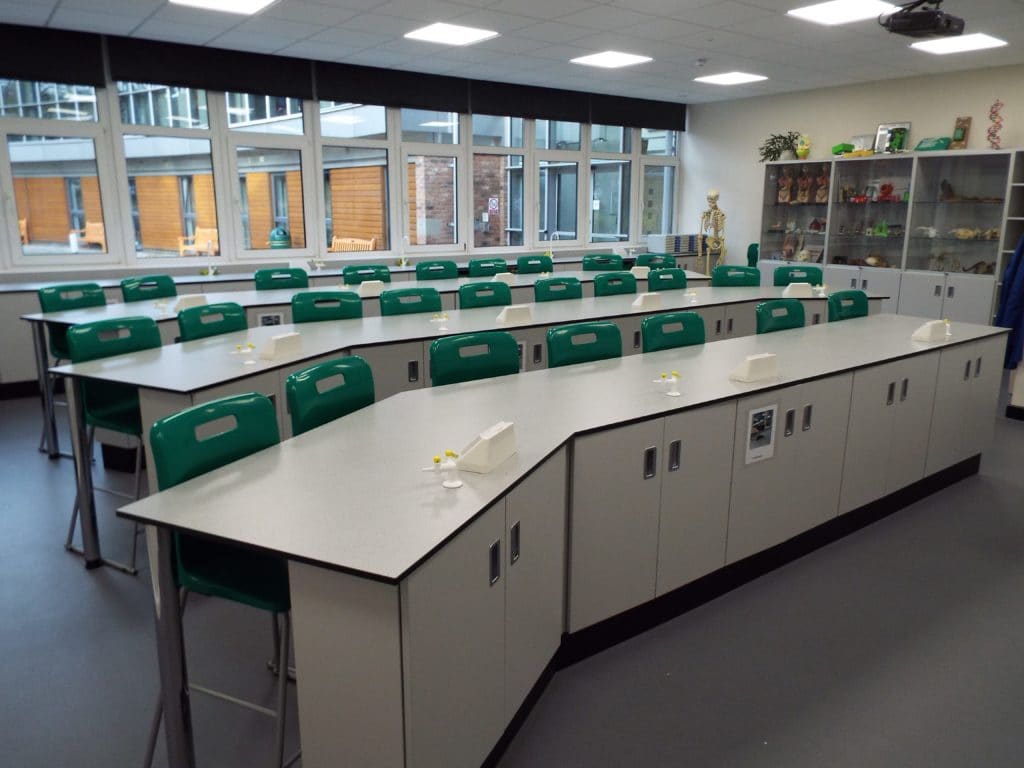
For example, science laboratories require sufficient spacing between benches to ensure students can work safely during practical lessons, while Design & Technology workshops need carefully planned zones for machinery and tooling. Defined zones also help learners move to the area best suited to each project phase.
Witley Jones creates detailed laboratory floor plans in line with CLEAPSS regulations regarding space planning and safe distancing between fixed furniture items, helping schools create compliant and efficient learning environments. A standing-height table or height-adjustable desk can help students sit or stand during longer tasks and make better use of floor space.
Thoughtful layout planning not only improves safety but also enhances classroom management and creates a more productive learning atmosphere.
STEM Furniture and Classroom Storage is Essential
Effective classroom storage is one of the most overlooked, yet most critical, aspects of STEM classroom design.
STEM subjects often involve specialist equipment, chemicals, tools, devices and teaching materials, all of which require safe, secure and organised storage solutions.
Without sufficient storage, classrooms can quickly become cluttered, difficult to manage and potentially hazardous; an organised room improves workflow and reduces clutter, which is often a major barrier during group projects.
When planning your storage requirements, consider:
- Chemicals and hazardous materials
- Scientific equipment and apparatus
- Technology devices and charging stations
- Design & Technology tools
- Teaching resources and demonstration equipment
- Student project storage
- Secure lockable storage for valuable items
Well-designed storage solutions improve organisation, reduce safety risks and help maximise available teaching space.
Witley Jones Furniture works closely with schools to develop bespoke storage solutions that meet practical teaching needs while making the most of the available space, with a focus on functionality. From integrated storage units and lockable cupboards to mobile storage systems and specialist technician areas, every solution can be tailored to your requirements, while multi-purpose furniture and storage support different tasks across the STEM space.
Mobile task carts can be carried or moved directly to student groups with the supplies needed for specific activities.
Prioritise Safety and Durable Materials
Safety should always be at the heart of every STEM classroom design.
The materials used in laboratories, science classrooms, and workshops must not only comply with relevant safety standards but also be durable enough to withstand heavy use in demanding educational environments and regular practical applications.
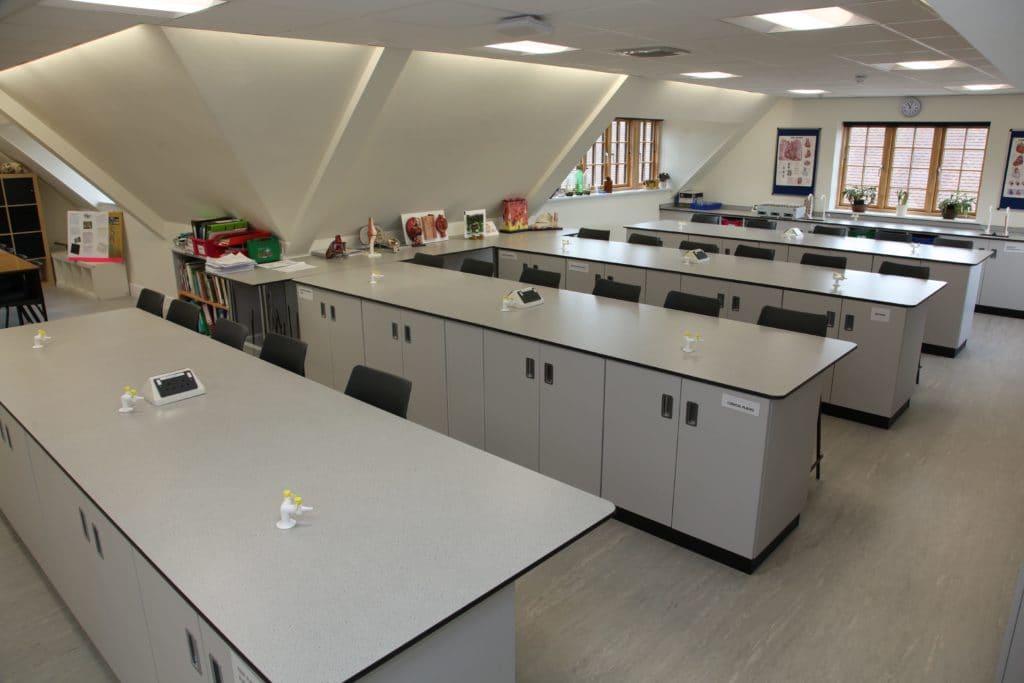
With increased focus on hygiene and infection control in schools, surfaces and furniture also need to be easy to clean and able to withstand frequent cleaning without deteriorating. High-quality lab tables built for heavy use and available in various sizes and configurations support both practical experiments and theoretical teaching.
Trespa Scientific Surface Solutions
Witley Jones proudly offers Trespa materials, recognised globally for high-performance scientific surface solutions.
Manufactured using natural fibres and thermosetting resins, Trespa panels provide:
- Excellent chemical resistance
- Scratch and wear resistance
- Long-lasting durability
- Hygienic and easy-to-clean surfaces
- Quick and efficient installation
These qualities make Trespa an ideal choice for science laboratories and STEM learning environments where reliability and performance are essential.
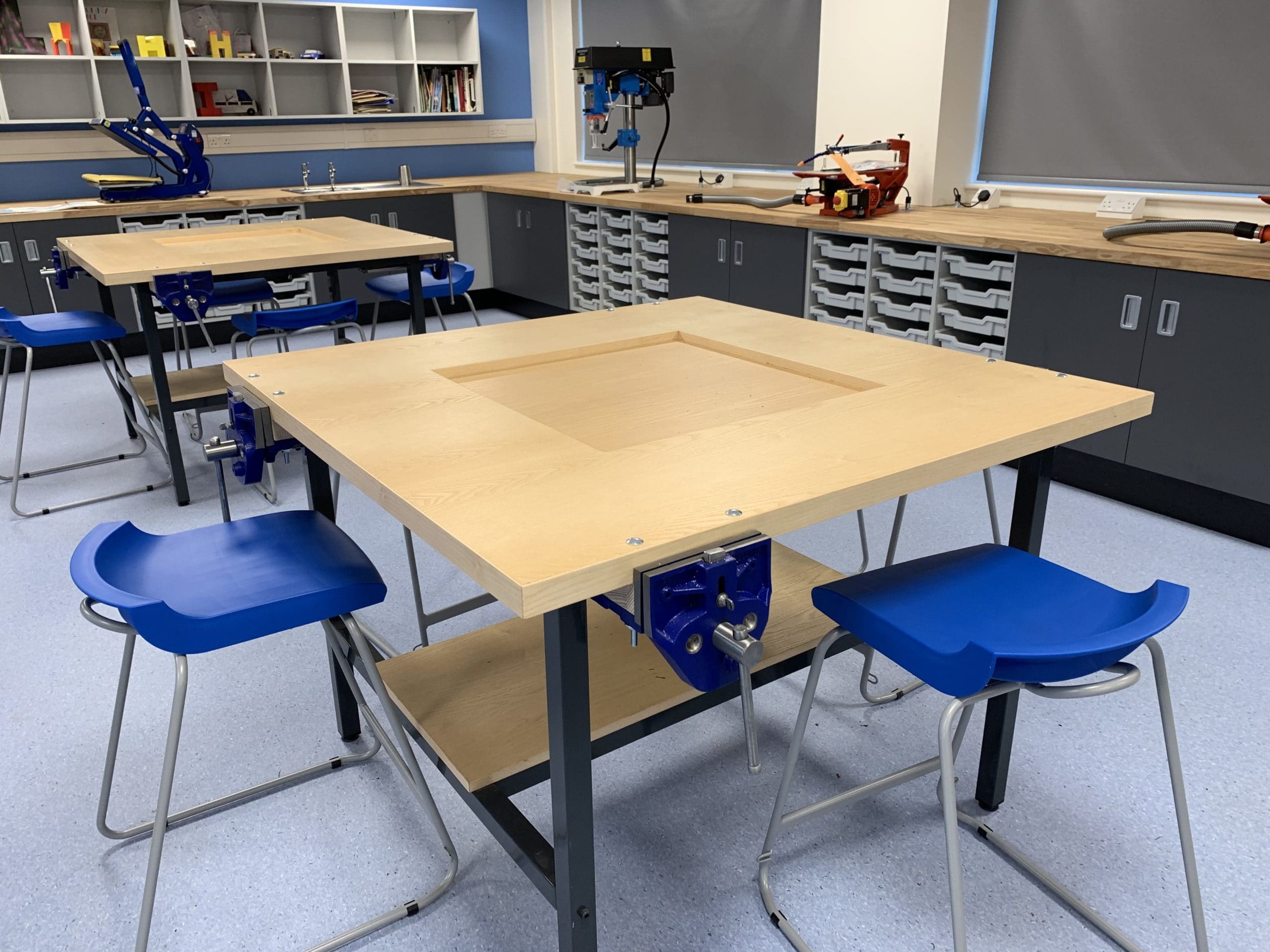
Hardwood Worktops for DT Workshops
For Design & Technology environments, robust work surfaces are equally important.
Witley Jones can supply premium hardwood worktops up to 40mm thick, providing secure and durable surfaces for attaching tooling and workshop equipment while also creating a high-quality finish that enhances the overall aesthetic of the space.
Available hardwood options include:
- Ash
- Oak
- Beech
- Maple
- Iroko
Worktops can also be professionally oiled to enhance appearance and extend lifespan. Bespoke sizing options are available, including varying depths and height settings to accommodate specific tooling and workshop requirements.
Use Colour to Create Inspiring Learning Environments
While practicality and safety are essential, the visual design of your STEM classroom also plays an important role in student engagement and wellbeing.
Colour schemes can influence mood, concentration and the overall feel of a learning environment.
Many schools choose to:
- Reflect the school branding and colours
- Use colour coding for different STEM subjects
- Create calm and focused learning environments
- Introduce bold feature colours to inspire creativity and energy
When selecting colours for desks, chairs, storage and furniture, consider whether you want:
- A consistent colour palette throughout the space
- Complementary tones within the same colour family
- Contrasting colours to create visual impact and personality
There are also practical considerations when choosing surfaces and finishes.
For example, light-coloured tabletops can make it easier to spot spills, chemical splashes or debris, while also making small components easier to see and retrieve during STEM activities, supporting faster cleaning and improved safety. Darker surfaces, while visually striking, can sometimes make spills harder to detect.
A carefully considered colour scheme can help create a modern, welcoming and engaging STEM learning environment that students enjoy spending time in.
Plan for Long-Term Flexibility
One of the biggest mistakes schools can make when designing STEM classrooms is focusing only on immediate needs.
Teaching methods, changing technology, and curriculum needs continue to evolve rapidly. Designing flexible spaces with modular pieces that schools can construct into different layouts over time helps protect your investment and ensures your facilities remain effective for years to come.
Future-proofing considerations may include:
- Flexible furniture layouts
- Mobile workstations
- Integrated power and data access
- Technology-enabled teaching areas
- Expandable storage solutions
- Adaptable teaching zones
- A mix of seating options, including wobble stools and chairs with lumbar support, for different activities and learner needs
Creating flexible STEM environments allows schools to respond more easily to future educational developments without requiring costly redesigns or refurbishments. Over time, stem furniture with integrated storage and adaptable layouts can support both practical experiments and theory discussions.
Create STEM Spaces That Inspire Future Generations
Designing successful STEM classrooms requires a careful balance of safety, practicality, flexibility, and visual appeal, with mobile whiteboard tables and other writable surfaces helping students collaborate and develop ideas through brainstorming and rapid iteration.
By taking the time to consider how the space will be used, prioritising effective storage and durable materials, and creating inspiring learning environments, schools can develop STEM facilities that support both teachers and students for many years to come. Mobile writable tables also help students work through math challenges and bring concepts to life in robotics and other STEM projects, while giving teachers greater visibility of thinking and moments of inspiration.
Whether you are planning a new science laboratory, refurbishing an existing classroom or creating a modern Design & Technology workshop, thoughtful design will help maximise your investment and improve the overall learning experience.
If you wish to discuss your STEM plans in more detail, then please get in touch and we will be happy to talk through your options.